Want to land more sales from your beauty email campaigns? Here's the thing most guides won't tell you: the emails aren't usually the problem. The timing is.
This guide breaks down 15 high-performing beauty email examples using a 5-stage customer journey framework, so instead of a random list of "inspiration," you get a clear map of which email to send, to whom, and when.
The 5-Stage Beauty Email Framework
Here's the honest truth about beauty email marketing: it's not really about email. It's about moments. A customer who just signed up needs something completely different from one who abandoned a cart at midnight, or one who's been buying from you loyally for two years.
Stage
Customer Moment
What High-Converting Emails Do
1. Capture & Personalize
New subscriber.They have raised their hand, but it isn't a sale yet.
Gather preference data. Use this moment to ask good questions and collect data gracefully so the subscriber feels seen rather than processed.
2. Educate & Guide
Browsing and considering.They are unsure which product is right for their specific skin or hair.
Reduce confusion. Answer the questions they are already Googling and offer expert consultations to build confidence before they buy.
3. Convert & Push Action
High intent and ready to buy.They know what they want but haven't pressed the button yet.
Remove hesitation. Create urgency and highlight value using expert endorsements, free gifts, or flash shipping offers.
4. Retain & Expand
Post-purchase and repeat buyer.A buyer who has already trusted you once.
Drive replenishment. Use loyalty rewards, routine guides, and subscription models to turn a single purchase into a long-term habit.
5. Re-engage & Recover
Drop-off and inactivity.They abandoned a cart or haven't opened an email in months.
Win back with warmth. Recover carts without being pushy and use empathy or "back-in-stock" surprises to remove barriers to coming back.
The brands that consistently drive 30%+ of revenue from email aren't lucky — they've systematically built flows for all five stages. Everything below is organized around this map.
Stage 1: Capture & Personalize
The new subscriber has given you their email address. That's not a sale, it's a raised hand. The question is what you do with it.
Beauty is one of the most personal categories in retail. Skin types, hair textures, scent preferences, and skin tones are the variables. Brands that win early do so by asking good questions, collecting that data gracefully, and making the subscriber feel seen rather than processed.
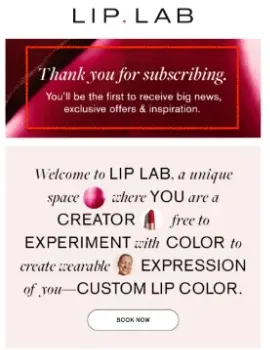
1. Tell Them What's In Store (Lip Lab)
Subject line: Thanks for subscribing to Lip Lab
Lip Lab's welcome email does something most welcome emails don't: it actually welcomes you. Rather than a single generic CTA and a logo, this email uses location-based segmentation to offer a genuinely relevant experience — in-store or at-home — and collects more user data along the way.
The CTAs evolve as you scroll. By the footer, the button has quietly changed from "Shop Now" to "Get Inspired" — a small but telling detail. It signals that this brand understands the difference between a customer ready to buy and one who's still looking around.
What to borrow from it:
Use your welcome email to gather preference data, not just confirm the signup
Offer multiple value propositions (in-store experience, product range, personalization), so different types of subscribers find something relevant
Make sure your email platform can handle real-time personalization — a generic welcome to someone in Tokyo and someone in Leeds is a missed opportunity
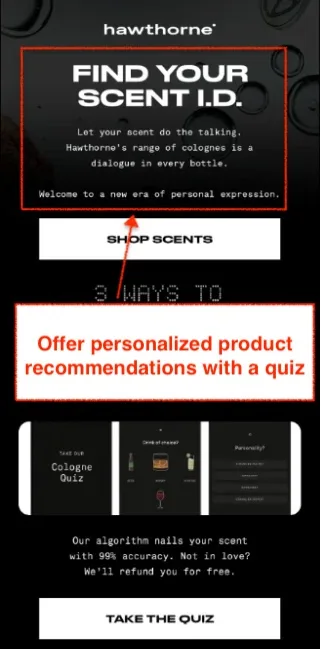
2. Help Them Find Their Signature Scent (Hawthorne)
Subject line: Discover the cologne that's uniquely you
Hawthorne sells fragrance, which is, if you think about it, one of the hardest things to sell online. You can't smell a pixel. Their solution is the quiz funnel, and this email is essentially a warm invitation into it.
The email uses clean typography to lead the eye, previews the steps ahead so subscribers know what they're signing up for, and cleverly pairs a confident upsell with a returns policy — which tells the reader: we're sure you'll like it, but we won't hold you hostage.
What to borrow from it:
Quiz funnels are especially powerful for beauty and fragrance because they turn preference data into product recommendations instantly
Your quiz landing page matters as much as the email — invest in good product imagery, ingredient lists, and testimonials
A clear, hassle-free returns policy mentioned early builds trust before the first purchase is even made
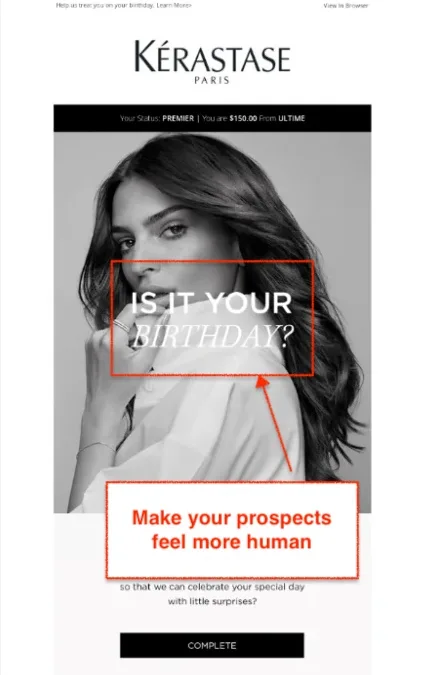
3. Ask Them for Their Birthday (Kerastase)
Subject line: We want to celebrate you, Eva!
This is an email doing three quiet things at once. It collects missing user data (the birthday), teases a loyalty reward ("$150 away from ULTIME"), and makes the subscriber feel like a person rather than a record in a database. There's no discount being given away — just the promise of one, which is a clever piece of behavioral economics.
What to borrow from it:
Use this as the final email in your welcome sequence, after trust is established
Frame data collection as a gift to the subscriber, not a request from you
A loyalty progress bar ("you're this close to your next reward") is one of the most effective nudges in retention email — it works because humans hate leaving things unfinished
Stage 2: Educate & Guide
The customer is browsing. They might have looked at three serums, two moisturizers, and a hair mask. They haven't bought anything because they're not sure which one is right for them. This is where most beauty brands go quiet and where smart ones speak up.
Beauty is not an impulse category for most people. "Will this work for my skin type?" is the question underneath almost every browsing session. The emails in this stage answer it.
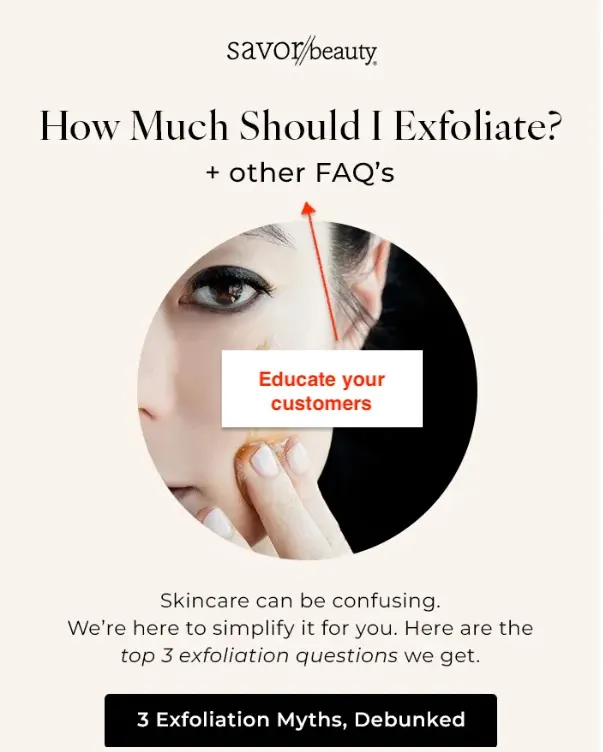
4. Answer the Questions They're Already Googling (Savor Beauty)
Subject line: Want FRESH skin in 3 minutes? ✨
Savor Beauty does something genuinely clever here: they've built an email out of FAQ content, sourced directly from real customer questions and search queries. The result doesn't feel like a promotional email at all it reads like a helpful article that happens to feature products.
Everything comes in threes: three questions, three product categories, three recommendations. The structure is clean enough that a reader who's in a hurry can scan it, and deep enough for one who wants to linger. There's even a quiet "low stock" urgency nudge buried in the Face Cream section, easy to miss on a first read, impossible to miss on the second.
What to borrow from it:
Go to Google Search Console → Search Results → Filter → Queries → Custom Regex → what|how|when|why|where. Those are your email topics
Send this format to new subscribers who haven't bought yet — it educates before it sells
The newsletter format works because it doesn't feel like selling. That's the point
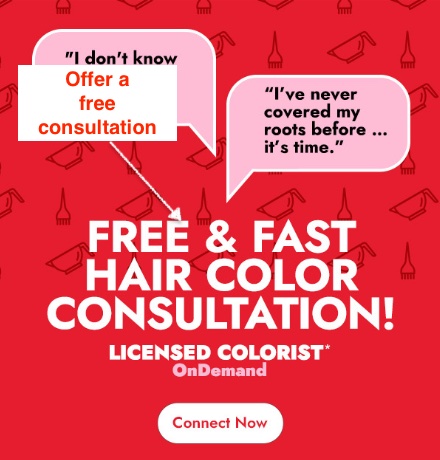
5. Offer Free Consultations (Sally Beauty)
Subject line: Thinking about coloring your hair? Chat with a Licensed Colorist for FREE
Sally Beauty uses the classic Problem-Agitate-Solution framework, but executes it unusually well. The email walks through the pain point (hair color confusion), presents the solution (a free consultation with a licensed colorist), and then spells out the steps so clearly that even an anxious first-timer knows what to do.
The images do the heavy lifting; you can understand the message without reading a word of the copy. And for subscribers who aren't ready for a consultation, there's an alternative offer waiting at the bottom.
What to borrow from it:
This works best for active subscribers, people who click through regularly but haven't converted
Make your footer a conversion tool, not an afterthought: social links, app install prompts, and trust badges all belong there
Free consultations dramatically lower the barrier to purchase in categories where customers feel uncertain
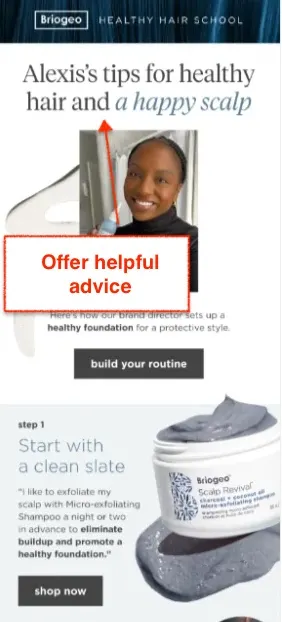
6. Teach Them a Routine (Briogeo Hair)
Subject line: Healthy hair tips 📝
The best thing about Briogeo's routine email is that it doesn't rely on images to make its point; the text alone carries the message, and the visuals simply enhance it. This matters more than people realize. Almost 43% of Gmail users read emails with images turned off. If your email depends on images to communicate, you're silent to nearly half your audience.
Briogeo uses employee-generated content, which gives the email an honest, human voice. At the bottom, there's a bundle offer with a "while supplies last" note — a light FOMO trigger that doesn't feel forced.
What to borrow from it:
Routine-based content is especially effective in hair and skincare because it contextualizes individual products within a system
Always use descriptive alt text on images, not just "product image," but something that carries meaning even when the image doesn't load
Send browse abandonment emails to anyone who clicked through from this email but didn't purchase
Stage 3: Convert & Push Action
The customer knows what they want. They just haven't pressed the button yet. This is the stage where urgency, value stacking, and a small removal of friction can make an outsized difference.
Conversion emails are the ones most brands spend the most time on, and often the ones where they try the hardest and say the least. The examples below work not because they shout, but because they understand what's holding the customer back.
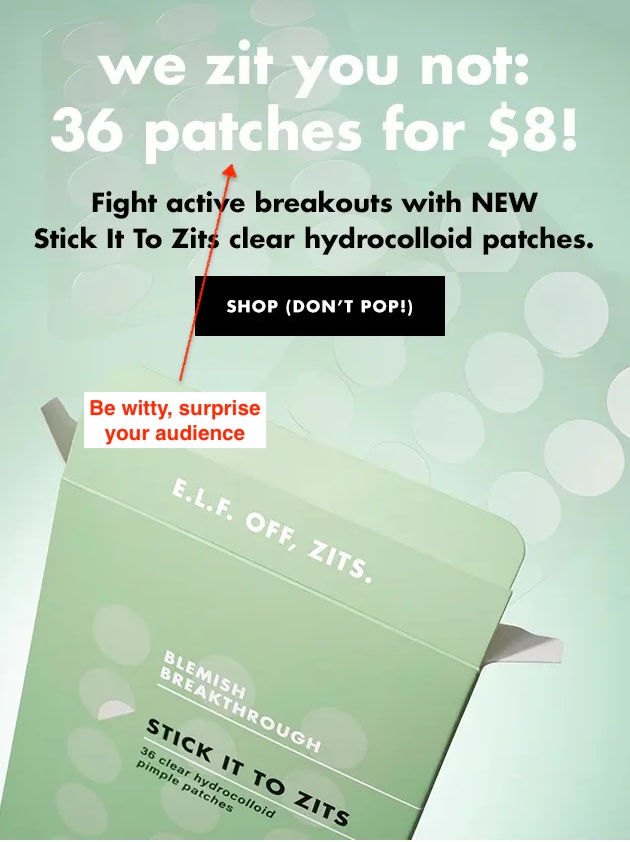
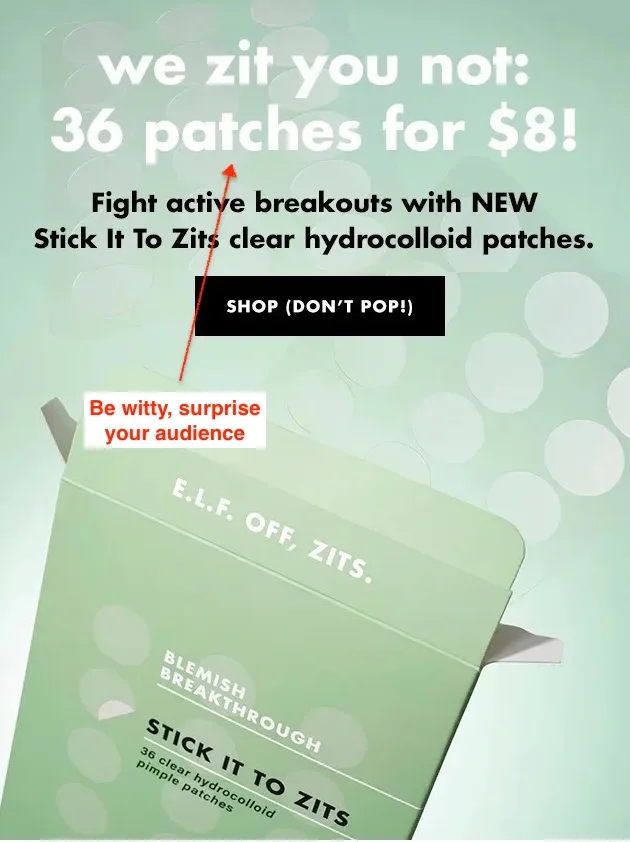
7. Frame a Product With a Pun (e.l.f. Beauty)
Subject line: $8 for 36 acne patches?! We zit you not 😜
This email earns its place in a marketing textbook for the subject line alone. But the rest of it holds up too: a dermatologist endorsement for credibility, a subtle loyalty points reminder for gamification, and CTAs that continue the joke ("Shop (Don't Pop)") without wearing it out. Product recommendations are pulled from browsing history, and there's even a quiz link for subscribers still deciding.
What to borrow from it:
A pun-based subject line works when it's genuinely funny, and when the product supports it, don't force it
Dermatologist or expert endorsement is particularly powerful in skincare; it moves the conversation from "this brand says it works" to "a qualified person says it works."
Send this as the second email in a product launch sequence — after the announcement, before the final push
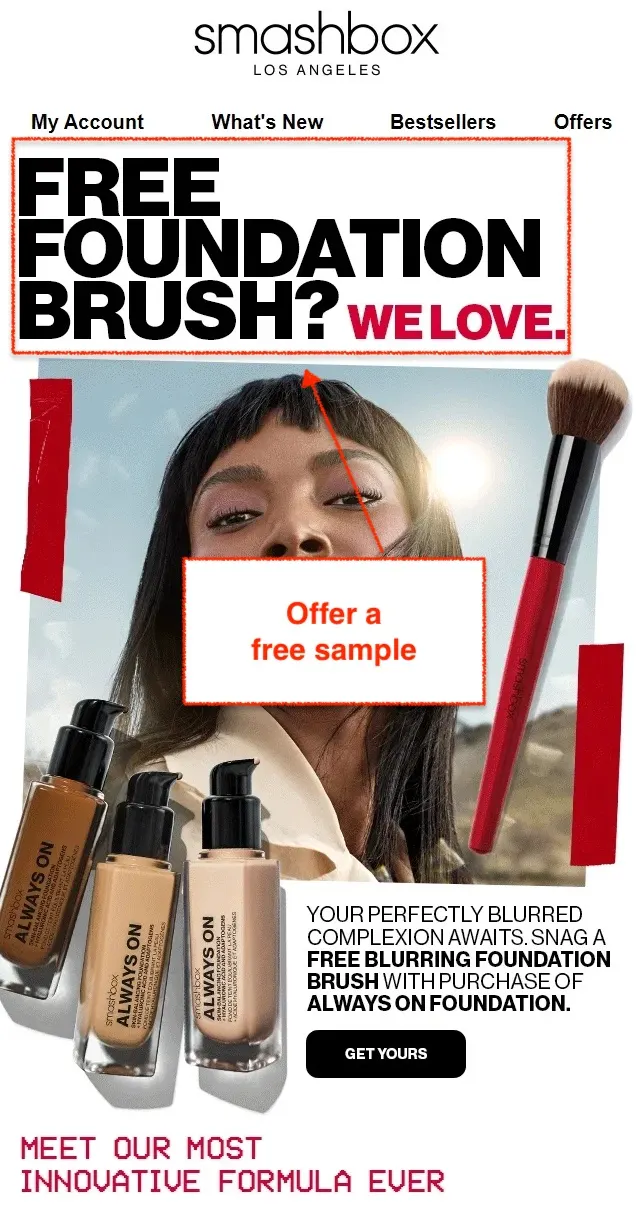
8. Make the Free Gift the Hero (Smashbox)
Subject line: Elevate your makeup routine with a FREE Foundation Brush 💞
BOGO buy one get one has become background noise in retail email. Smashbox found something sharper: a gift, positioned as the reason to buy rather than a sweetener. The email is easy to scan, shows subscribers what goes with what, and has a gamification element that reminds them of how long they've been a customer, a tactic that makes the reader feel invested rather than solicited.
What to borrow from it:
Free samples convert at rates as high as 30% a gift offer in an email is one of the most efficient conversion drivers available
Mention your three most powerful conversion levers explicitly: free shipping, free returns, and free samples
BNPL (buy now, pay later) options should be visible and explained simply. Smashbox does this well in the footer
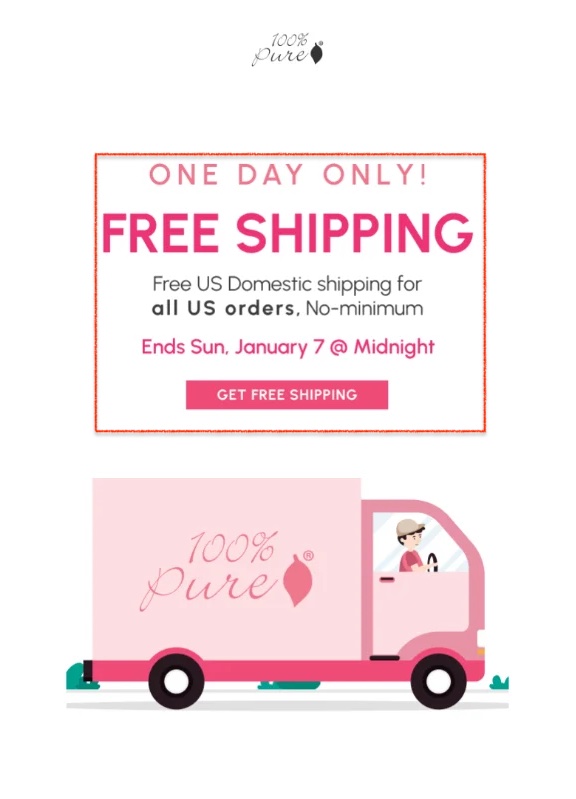
9. Run a Flash Free Shipping Day (100% Pure)
Subject line: 🎁 Sunday Surprise: Enjoy Free Shipping on Us Today!
The genius of this email is how it doesn't look like most promotional emails. 100% Pure uses minimal imagery — this one is text-heavy, which sounds like a liability, but in practice reads as more trustworthy. The copy is clean and direct, the design is mobile-friendly, and the "Happy Promise" section handles the returns policy with a light, confident touch.
What to borrow from it:
Build a 3-email sequence: tease the offer 3 days in advance, send the main email on the day, and send a final reminder before midnight — but filter out anyone who's already purchased
Try a pre-announcement subject line like "brace your 💰something's coming Sunday."
Free shipping removes one of the most common reasons people abandon carts; it's a conversion tool, not just a perk
Stage 4: Retain & Expand
The customer has bought from you. This is the moment most brands relax and the moment the best ones lean in. Getting a customer to buy a second time is far cheaper than finding a new one, and the lifetime value of a repeat buyer in beauty is substantial.
The magic words in this stage are: routine, replenishment, reward.
10. Make Their Annual Recap a Shopping Moment (Beauty Bay)
Subject line: Your BEAUTY BAY, wrapped 🔁
Spotify Wrapped became a cultural moment because people like to feel seen, quantified, and celebrated. Beauty Bay applied the same logic to their email list. This "wrapped" email features best-sellers, out-of-stock products, trend predictions for the year ahead, and new brand discoveries, all packaged as a personal recap.
For non-engagers, you can flip the format entirely: "Here's what you've been missing out on" targets FOMO rather than nostalgia.
What to borrow from it:
Mix this format into promotional emails by offering bundles with custom packaging
Encourage subscribers to share their wrapped on social — it's free UGC
Send non-openers a version that leans into what they missed, not what they did
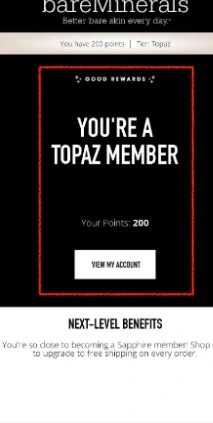
11. Show Them Their Loyalty Level (bareMinerals)
Subject line: Your Good Rewards recap
This email does what loyalty programmes so rarely do: it explains itself clearly. The tiered rewards structure is laid out plainly — no jargon, no fine print buried three scrolls down. The "Complete your Collection" cross-sell is integrated naturally rather than slapped on at the end.
What to borrow from it:
Personalise product recommendations by session duration — show them what they spent the most time looking at, not just what's popular overall
Loyalty tier emails work best when they show the subscriber exactly how close they are to the next level
A clear progress indicator (points to next reward) outperforms a general "you have X points" message every time
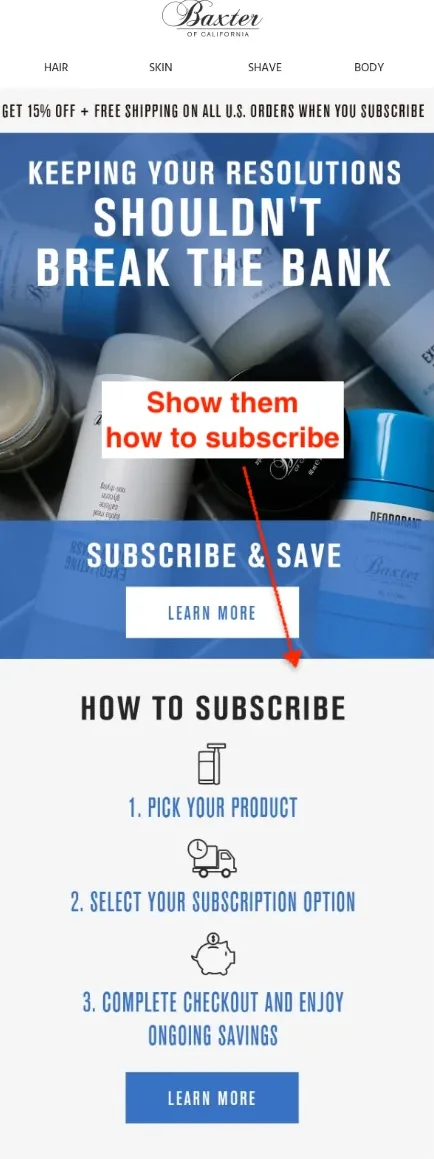
12. Push the Subscription Model (Baxter of California)
Subject line: Save 15% off today!
Baxter's email is essentially a polite but persistent argument for why subscriptions make financial sense. It shows the subscriber their most-purchased product, tells them how much they'd save by subscribing, and walks them through the sign-up process step by step. There's no confusion about what they're being asked to do.
What to borrow from it:
Follow up successful subscriptions with an email quantifying their savings. This reinforces the decision and reduces cancellations
For the follow-up, use copy like "You're saving $XX a year" rather than "thanks for subscribing" — the number makes it real
Repeat purchases account for roughly 35% of revenue for eCommerce businesses; subscriptions are simply a formalised version of that behaviour
Stage 5: Re-engage & Recover
The customer has gone quiet. Maybe they abandoned a cart. Maybe they haven't opened an email in four months. Maybe they bought once and drifted. This stage is about removing whatever is standing between them and coming back.
The instinct is to offer discounts. Sometimes that's right. But the examples below show that empathy, curiosity, and a gentle nudge often do more work than a promo code.
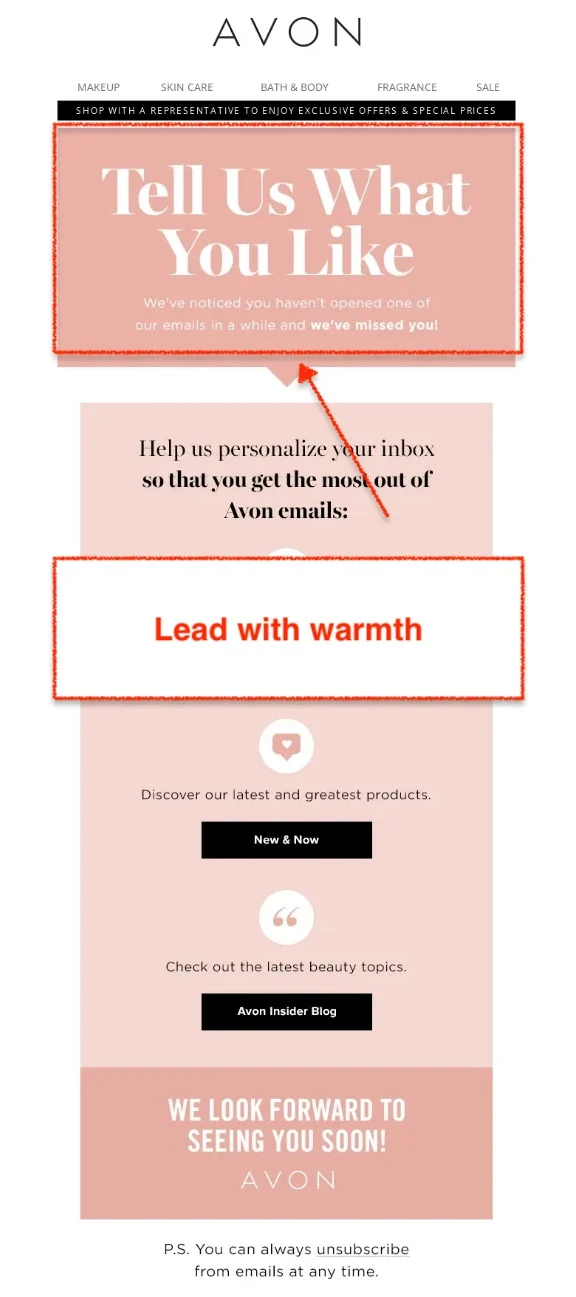
13. Win Them Back With Warmth, Not Discounts (Avon)
Subject line: Let's Try This Again!
Avon's win-back email is notable for what it doesn't do: it doesn't lead with a discount. Instead, it leads with warmth, offers the subscriber a choice of what they get, and reminds them of the brand's wider values — including a charity partnership and an affiliate programme. The tone is more "we missed you" than "please come back."
What to borrow from it:
If this email isn't opened, send a follow-up with a subject line like "We'll be removing you in X days" — this scarcity nudge consistently improves open rates
Remove subscribers who haven't engaged in over a year and haven't purchased: a clean list improves deliverability and sender reputation
For past purchasers, extend the re-engagement drip before removing them; their data is more valuable
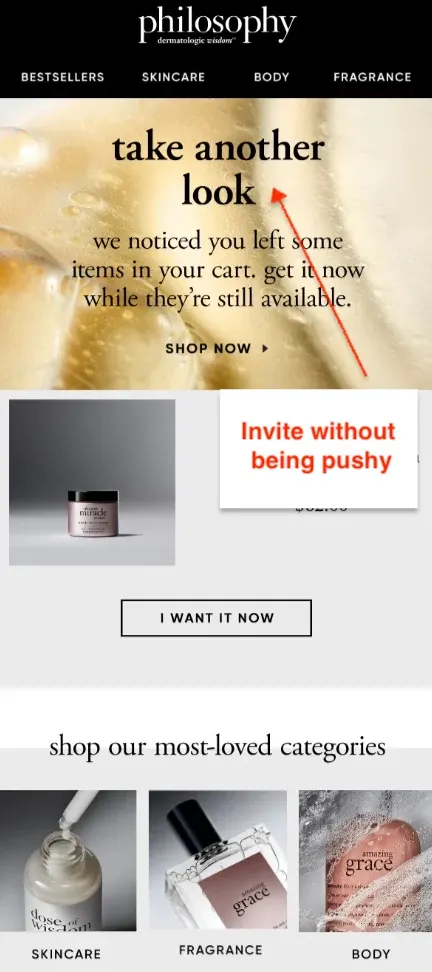
14. Recover the Cart Without Being Pushy (Philosophy)
Subject line: You Sure You Want To Pass This One Up?
The best cart abandonment emails don't lecture the customer about what they left behind. Philosophy's subject line is a question — it invites rather than chases. Inside, there's a personalised upsell, an urgency-driven CTA ("I Want It Now"), and a clean mobile layout that doesn't overstay its welcome.
Only 18% of brands include a discount in cart abandonment emails, and 80% of those do it in the first email. That's too early. Philosophy leads with a value rewards programme, free shipping threshold, and savings discounts (if needed) for a later email in the sequence.
What to borrow from it:
Structure your cart abandonment sequence: email 1 is value + reminder, email 2 is social proof, email 3 (if needed) is a discount — in that order
Mobile-first design is essential; the majority of cart abandonment emails are opened on phones
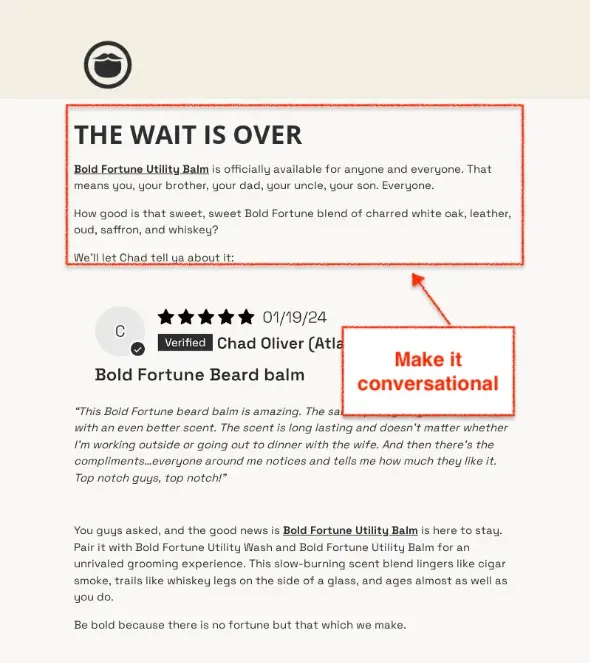
15. Surprise Them With a Back-in-Stock (Beardbrand)
Subject line: SURPRISE! Bold Fortune Utility Balm is available now
Beardbrand has built a brand around a particular kind of voice — unhurried, conversational, slightly wry. This back-in-stock email doesn't break from that. There's no aggressive CTA, not much text, and no discounts. Just a single review to establish the product's credibility, and a tone that feels like a message from a friend who thought you'd want to know.
What to borrow from it:
If you have a "Notify Me" button on out-of-stock product pages, send this email to those subscribers first — they've already raised their hand
Transactional emails are still brand emails; don't let your back-in-stock messages sound like they were written by a different company
Make the unsubscribe easy. Beardbrand does this memorably, with a note that's sentimental without being cloying. Customers who can leave easily are more likely to stay.
7 Email Templates to Put This Into Practice
These templates map to the five stages above. Adapt them, personalise them, and always test subject lines against your own audience.
Subject line: Your [Product Name] arrived — here's how to get the most from it
Hi [Name],
Your order is with you now.
Here's a quick guide to getting the most from [Product Name]:
Step 1: [Instruction — keep it plain, no jargon] Step 2: [Instruction] Step 3: [Instruction]
Pro tip: [One genuinely useful tip that most people miss]
In a few days, we'll ask you how it went. In the meantime — enjoy it.
[Watch [Influencer Name] Use It →]
A Final Note on Getting This Right
There's a version of beauty email marketing that treats subscribers like entries in a spreadsheet — and a version that treats them like people who've invited you into their inbox.
The brands that drive serious revenue from email, 30%, sometimes more, tend to be doing the second thing. They're not sending more emails. They're sending better-timed emails to people who are actually ready to receive them.
Cover all five stages. Test consistently. And remember that the goal of every email, at every stage, isn't just a click, it's a slightly stronger relationship than the one you had before you sent it.




.avif)
.svg)


.svg)

.svg)
.svg)
